Facts checked October 28, 2026 · Sources linked inline and listed below
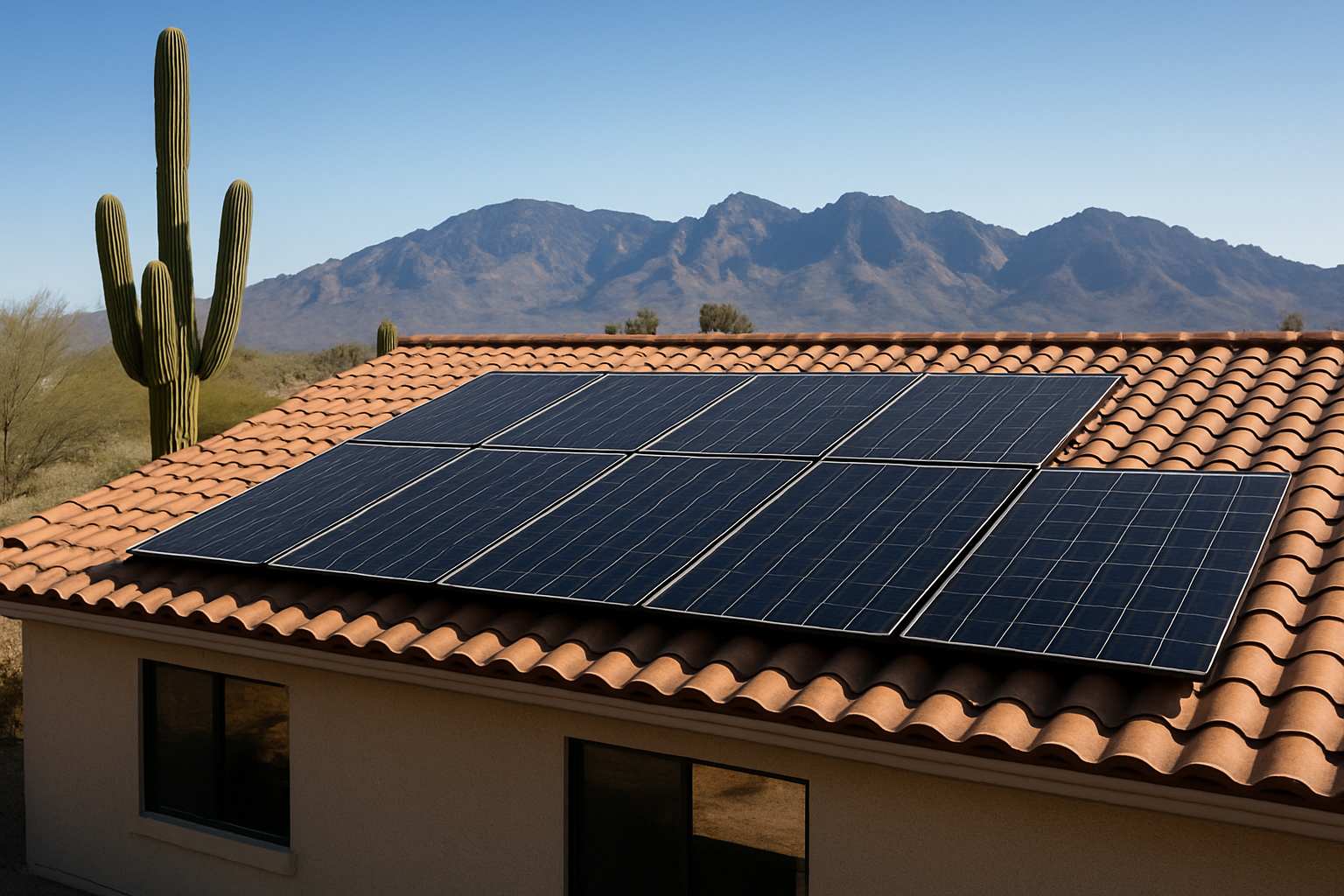
Tucson has more sun than it knows what to do with, but the money math on rooftop solar has changed. Tucson Electric Power no longer offers net metering to new customers; it pays a set export rate that it resets every fall. The federal tax credit that carried most solar quotes through 2025 is gone for systems finished since then. And a summer of triple-digit days does not help panels the way people assume.
This guide collects the local permit rules, the utility's interconnection and export terms, Arizona's licensing and contract rules, and the climate facts that matter for a Tucson system, with a link to the source behind each one. It is general information, not legal, tax or engineering advice. Your installer, your utility and the permit office have the final word on a specific house.
Solar permits: City of Tucson or Pima County?
Who issues the permit depends on where the parcel sits, not on the mailing address. Inside city limits, the City of Tucson's residential solar permit page points eligible projects to SolarAPP+, an automated plan review that only licensed solar contractors can use. The installer submits the design at gosolarapp.org, which charges a $35 processing fee for PV or $25 for PV plus storage, then applies for the permit through the city's TDC Online portal using the SolarAPP+ approval number. The city says the permit is issued within 24 hours, once its permit fee is paid, and inspections can be scheduled as virtual inspections. The city page does not publish the permit fee itself, so ask your installer what it came to.
Not every house qualifies for the fast lane. The city limits SolarAPP+ to rooftop systems on the main dwelling of a permitted residential structure, and excludes ballasted systems, homes that already have a PV system, and properties in a special district, historic preservation zone, environmentally sensitive area, hillside development zone or flood hazard area. Projects in a historic or neighborhood preservation zone go through regular review. In a flood hazard area, a leased system can still use SolarAPP+, but a system the owner buys needs a traditional plan review.
Outside city limits, unincorporated parcels are handled through Pima County's Solar One Stop. The county uses the same SolarAPP+ review with similar exclusions, takes applications through its Permit Gateway, and issues the permit on payment of a $94 permitting fee. If your address is in a different incorporated town, check with that town's permit office before anyone files.
If you live in one of Tucson's historic preservation zones, expect design review on top of the permit. The city's guide to green retrofits for historic homes says exterior changes in the six zones must meet zone-specific standards, even when no building permit is required, and suggests placing panels behind parapets on flat roofs, on the rear slope of a gable roof, or on an accessory structure.
How Tucson Electric Power connects and pays for rooftop solar
If your bill comes from Tucson Electric Power, TEP's approval comes before construction. Its installer interconnection page says the installer files the application through TEP's PowerClerk portal and that construction may begin only after TEP approves the project. TEP's homeowner page lays out the rest: an initial paperwork review within 7 days, a technical review of 14 to 21 days, installation and a notice of completion with photos, a possible TEP inspection, a new production meter, and then Permission to Operate. The system should not be switched on before that last step.
Exports are paid under TEP's Resource Comparison Proxy, not net metering. According to TEP's RCP page, the export rate is $0.0462 per kWh from October 1, 2026 through September 30, 2027. A customer keeps the rate in place when they requested interconnection for up to 10 years, and TEP says the RCP cannot fall more than 10 percent a year. The Rider-14 tariff adds the fine print: the system can be no larger than 125% of the home's connected load, unused credits roll forward, and each October TEP pays out a remaining credit balance over $10. Adding more than 10% or 1 kW of capacity during the 10 years (whichever is greater) can move you onto a newer rate.
Two more TEP rules shape the savings. All new solar customers must take a time-of-use or demand time-of-use plan, and the summer peak runs from 3 to 7 p.m. on weekdays, when rooftop output is falling. TEP's own solar overview warns that solar homes still get much of their energy from the grid, often more than half, and that future rate changes could affect the savings a seller projects. Homes that went solar before 2018 on grandfathered net metering stay on Rider-4, which has a 20-year term.
Not every Tucson-area address is a TEP customer. If your bill comes from Trico Electric Cooperative, its member solar FAQ says net metering closed to new residential applications in February 2017, new systems go on its annual export tariff, applications are filed through PowerClerk with no application fee, and the installer must hold an active Arizona license.
Ready to compare window quotes in Tucson? It's free and there's no obligation.
Get Free QuotesHeat, monsoon storms and what they do to panel output
Tucson's sun is strong, but its heat works against panels. The National Weather Service lists a 1991–2020 normal of 68 days a year at 100°F or hotter at the airport, with a normal June high of 101.2°F. The city's all-time record is 117°F, set on June 26, 1990. This year ran hotter than normal: the NWS Tucson office's 2026 monthly reviews record the earliest first triple-digit high on record on March 19, and 70 days of 100°F or more during summer 2026.
A U.S. Department of Energy report on PV system performance explains why that matters. Panels are rated at a cell temperature of 25°C (77°F), cells usually run hotter than that in the field, and output drops by a set percentage for each degree above the reference, a figure called the temperature coefficient. The report's example is 0.4% per degree Celsius. The same report puts typical module degradation at about 0.5% a year. In practice, compare the temperature coefficient of power on each panel's spec sheet, and ask whether the production estimate in your quote accounts for Tucson temperatures rather than lab ratings.
Monsoon season adds wind and hail. The NWS 2026 reviews describe severe storms crossing the metro area on July 11 with gusts of 55 to 70 mph, including an 81 mph gust at Davis-Monthan Air Force Base, and half-dollar to ping-pong-ball-sized hail on August 19, the same day storms brought down power lines. Ask how the racking is attached and sealed, what wind and hail ratings the panels carry, and what the warranty says about storm damage. TEP notes that a system with battery storage may still provide power during an outage, depending on how it is set up; a quote should say plainly whether yours will.
Building code and Tucson's solar-ready homes
The City of Tucson's building codes page says the 2024 International Residential Code and the 2023 National Electrical Code took effect on January 1, 2026, with the 2024 energy code following on July 1, 2026. The city reviews these codes with Pima County and adopts local amendments. Its 2024 IRC amendments adopt the code's solar-ready appendix, with some sections deleted, including the requirement that the reserved roof area face between 90 and 270 degrees of true north.
Tucson has required solar readiness for years. A city summary of its solar-ready ordinance says that starting July 1, 2009, plans for new single-family homes and duplexes had to include a solar system or the groundwork for one: a marked spot for the meter, disconnect and inverter, a roof area designed for about 4 pounds per square foot of added weight, a 3,800 volt-ampere PV load in the electrical calculation, and a breaker space labeled for PV. If your house was permitted in the city after that date, ask your installer to check whether those provisions are in place before designing around a panel upgrade.
Tax credits in 2026: the federal credit is gone, the state credit is small
The IRS says the Section 25D residential clean energy credit is not allowed for expenditures made after December 31, 2025, and that an expenditure counts as made when installation is completed. The IRS also answers the obvious workaround: paying in 2025 for a system installed after that date does not qualify. A system finished in 2026 gets no federal credit, so any quote that still subtracts a federal credit from the price of a system you buy is out of date.
Arizona's own credit is still on the books, but it is modest. The Arizona Department of Revenue's Form 310 instructions (2024 tax year) describe a credit of 25% of the cost of a solar energy device installed in your Arizona residence, capped at $1,000 per residence across all years, with unused credit carried forward up to five years. Leased systems and power purchase agreements do not qualify. Check the current year's form with ADOR before you count on it.
Under Arizona law, any sale, lease or financing contract for a rooftop system must carry specific disclosures. TEP will reject an interconnection application without a signed acknowledgement of those requirements, which include a statement that utility rates and projected savings can change, a warning that tax incentives may change or end, and, if the contract estimates future utility costs, a range of at least plus or minus 5%.
Hiring in Arizona: ROC licensing, warranties and the roof
Arizona contractors are licensed by the Registrar of Contractors. The ROC's license classification requirements list the residential R-11 and dual CR-11 electrical licenses with a solar warranty requirement when solar work is performed. The ROC's advice before you hire is to look up the license in its Contractor Search, make sure the license class covers the work in the contract, and get a written contract with the price, who pulls permits, the license number and start and finish dates. It also warns against letting payments get ahead of the work and against paying cash. The Residential Contractors' Recovery Fund can pay up to $30,000 per homeowner when a licensed residential contractor fails to perform, subject to its conditions.
State law adds two protections specific to solar. A.R.S. 44-1762 requires a written warranty of at least two years on collectors, heat exchangers and storage units and their installation (or an energy production guarantee), and at least one year on the remaining components. Before a rooftop install, the contractor must evaluate the roof, recommend an inspection by a licensed roofing contractor, and repair roof damage the installation causes.
TEP keeps a list of qualified installers but says it does not endorse any of them, and asks customers to report anyone claiming to be a TEP preferred or approved installer by calling 520-623-7711, according to its homeowner page. If an installer goes out of business mid-project, TEP's orphaned-project FAQ says it will help reassign the job to a new company and that the project keeps the export rate from its original application.
Solar installers in Tucson
These businesses appear in public Google Maps listings for solar installation in Tucson (checked October 28, 2026). HomeLynk is not affiliated with them and does not rank, rate or endorse them. When you request quotes through HomeLynk, you are matched with contractors from our own network, which may or may not include these companies. Verify any contractor's license with the Arizona Registrar of Contractors before signing.
Technicians for Sustainability
E 19th St, central Tucson
Solar installation and solar system service
Solar Gain
E 17th St, central Tucson
Solar installation, electrical work and solar equipment
ReWired Energy
E 7th St, near downtown
Solar installation, service and batteries
Saguaro Solar, Electric, and Roofing
N Campbell Ave, midtown
Solar, electrical work and EV charger installation
The Solar Store
N Country Club Rd, midtown
Solar system service
Net Zero Solar
W Silverlake Rd, west of downtown
Solar installation and equipment supply
Sunbright Solar, LLC
S Dodge Blvd, south-central Tucson
Solar installation and service, EV charging and electrical work
Advanced Electric and Solar
E 29th St, east-central Tucson
Solar installation, service and equipment
Questions to ask before you sign
- Is my parcel in the City of Tucson, unincorporated Pima County or another town, and does it qualify for SolarAPP+?
- Who files the TEP (or Trico) interconnection application, and will you wait for approval before starting work?
- Which export rate will my application lock in, and how does the system size compare with TEP's 125% of connected-load limit?
- Does the production estimate assume Tucson summer temperatures, and what is the panels' temperature coefficient of power?
- What is your Arizona ROC license number and classification, and does it cover this work?
- Will a licensed roofing contractor inspect the roof first, and who pays for roof repairs caused by the install?
- Does the quote show any federal tax credit, and if so, on what basis given the 25D end date?
- What do the panel, inverter and workmanship warranties cover, and for how long?
Related guides
Sources
- City of Tucson — Residential Solar Permits (SolarAPP+)
- Pima County — Solar One Stop
- City of Tucson — Building Codes
- City of Tucson — Amendments to the 2024 International Residential Code
- City of Tucson — Solar-ready ordinance summary
- City of Tucson — Sustainable Historic Homes retrofit guide
- Tucson Electric Power — Resource Comparison Proxy export rate
- Tucson Electric Power — Rider-14 RCP tariff
- Tucson Electric Power — Residential solar for homeowners
- Tucson Electric Power — Residential interconnection for installers
- Tucson Electric Power — Thinking about solar?
- Tucson Electric Power — Consumer acknowledgement (A.R.S. 44-1763)
- Tucson Electric Power — Orphaned project FAQs
- Trico Electric Cooperative — Member-installed solar FAQ
- NWS Tucson — Monthly and daily normals and records
- NWS Tucson — All-time extremes
- NWS Tucson — Monthly and seasonal reviews for 2026
- U.S. DOE — Understanding Solar Photovoltaic System Performance
- IRS — FAQs on Sections 25C and 25D under Public Law 119-21
- Arizona Department of Revenue — Form 310 instructions (2024)
- Arizona Legislature — A.R.S. 44-1762, solar energy device warranties and installation
- Arizona ROC — License Classification Requirements
- Arizona ROC — Before You Hire a Contractor
- Arizona ROC — Contractor Search