Facts checked October 28, 2026 · Sources linked inline and listed below
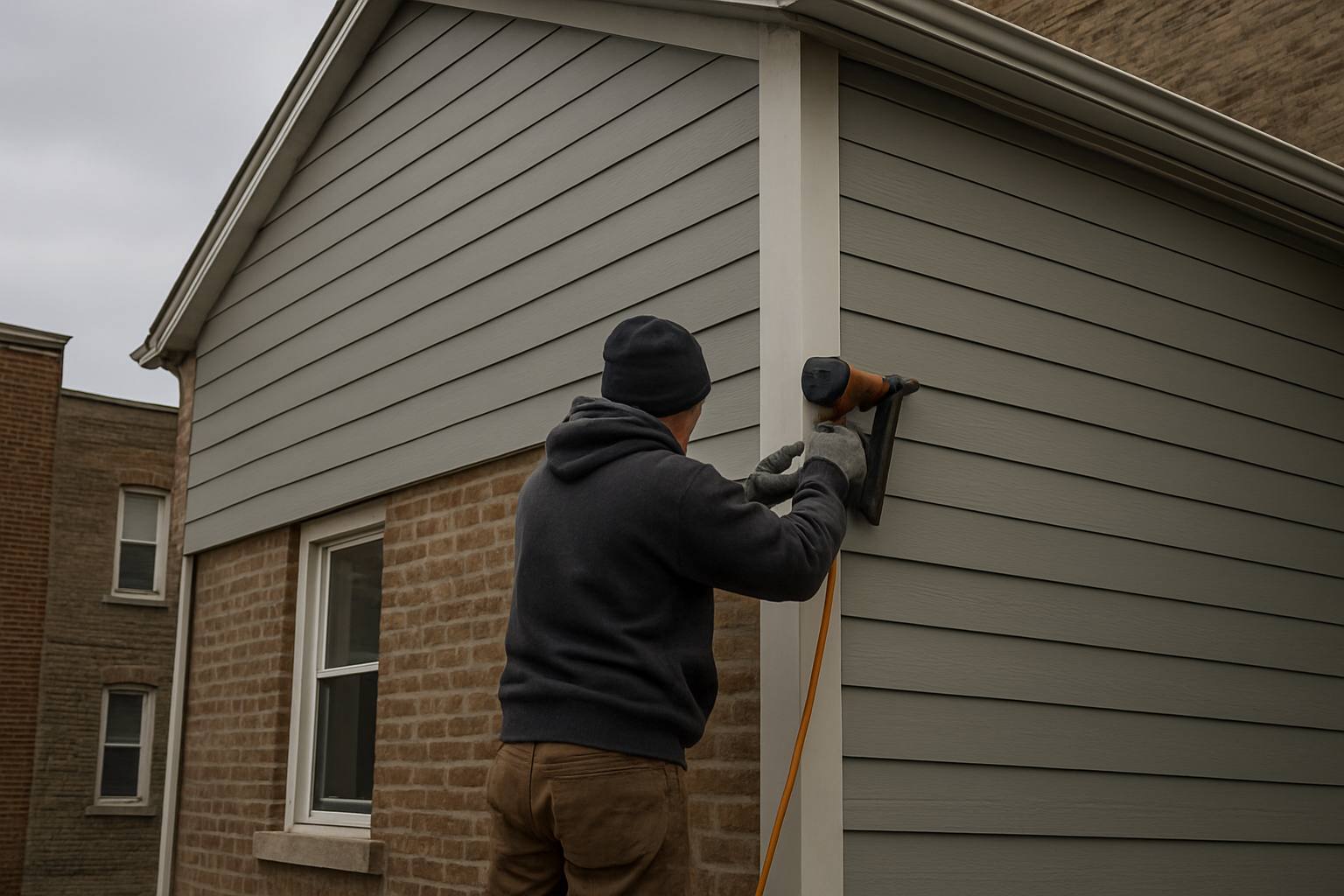
Re-siding a house in Chicago means working through rules that are specific to the city. Chicago writes its own building code and licenses its own contractors. It also runs a landmarks commission that reviews exterior work on designated buildings and in landmark districts. Federal lead-paint rules apply to paid work on homes built before 1978, and the weather puts siding through deep cold and violent summer storms.
This guide gathers the city rules and published standards that apply, with a link to the source behind each one. It is general information, not legal or code advice. The Department of Buildings, the landmarks staff and your installer have the final word on a specific building.
Do you need a permit to replace siding in Chicago?
The clearest statement we found is in the Department of Buildings' homeowner guide to permits, dated October 2019. It lists "replacing siding" among projects that don't need a building permit, and names vinyl, aluminum, wood, EIFS and similar nonstructural exterior finishes on residential buildings. There is a catch: that exemption does not apply if the building is a Chicago Landmark or sits in a Chicago Landmark District.
Treat that guide as a starting point, not the last word. Chicago rewrote its construction codes around the same time. According to the city's code modernization summary, the new Building Code is based on the 2018 International Building Code and International Existing Building Code, and it became mandatory for permit applications started on or after August 1, 2020. Ask the Department of Buildings to confirm the current rule for your job before work starts, especially if sheathing, framing or windows will be touched along the way.
Mixed-use buildings follow a different rule. The department's Quick Guide to Business Repairs says a permit is always required to repair exterior brick or siding on nonresidential buildings. If your two-flat has a storefront on the ground floor, ask how the building is classified.
When a permit is needed, many smaller jobs go through the online Express Permit Program, launched in November 2023. Its published list of guided work types includes masonry, reroofing, and window and door replacement, but not siding. If a contractor will be named on an express permit, the city emails that licensed contractor, who must accept the job before the permit issues.
Siding on a Chicago Landmark or in a landmark district
The city's Historic Preservation Division reviews all permit applications for work on designated and proposed Chicago landmarks and landmark districts. The aim is to keep work from harming the significant historical or architectural features of the property. The Landmarks Commission encourages owners to ask for advice before filing.
The commission's owner Q&A says no extra city permit is required for landmark buildings; the commission reviews permits as part of the normal building permit process. In landmark districts, the significant features are typically the exterior elevations visible from the public right-of-way. That is often exactly where new siding goes. Review criteria are based on the U.S. Secretary of the Interior's Standards for Rehabilitation, and the city's policies are set out in its Guidelines for Alterations to Historic Buildings and New Construction.
The division's 2025 submission requirements list siding among the alteration types it reviews. Applicants should expect to provide photographs of the property and material samples or mock-ups. Staff may hold off on reviewing an application until the submittal is complete. The office is at 121 North LaSalle Street, Room 1000, and the listed phone number is 312-744-3200.
- Find out early whether your building is a designated landmark or inside a landmark district.
- If it is, plan on a permit and staff review even though ordinary siding replacement elsewhere in the city may not need one.
- Have your contractor gather elevation photos and a sample of the proposed siding before you file.
Ready to compare window quotes in Chicago? It's free and there's no obligation.
Get Free QuotesChicago's own building code and combustible siding
Chicago writes its own Building Code on the 2018 IBC base described above, and the Department of Buildings issues formal interpretations of it. One local rule worth knowing about is a Department of Buildings interpretation on noncombustible exterior walls, issued November 9, 2018. It says exterior wall coverings on buildings of Type I, II and III construction must be noncombustible, with limited exceptions. It also says other combustible materials are generally prohibited on the exterior side of those walls, with limited areas allowed case by case through an Alternative Code Approval.
Under the same interpretation, fiber-cement siding counts as noncombustible if it meets IBC Section 1403.10. If it goes over a combustible water-resistive barrier, the assembly also has to meet the stated fire-test requirements. Fire-retardant-treated wood does not count as noncombustible.
We could not find a city source saying which construction type covers a typical Chicago house, so we are not going to guess. If you own a masonry building, a larger multi-unit building or anything with a mixed construction history, ask your contractor which construction type applies and whether vinyl or wood is allowed on the walls you want to cover. Get the answer in writing before you choose a product.
Storms, cold snaps and what they mean for siding
Summer storms here can be severe. On July 15, 2024, a derecho produced 32 confirmed tornadoes in the National Weather Service's Chicago forecast area, a record for a single event. Four touched down inside city limits, the most on record for one event in the city. The weather service estimated straight-line winds of 70 to 80 mph across southern Chicago, and damage consistent with winds up to about 80 mph in the Austin area.
Four years earlier, the August 10, 2020 derecho put an EF-1 tornado through Rogers Park. It formed near Lincolnwood and went out over the lake near Jarvis and Fargo beaches. The weather service's storm survey estimated its peak winds at 110 mph. Hail reaches the city as well: on March 30, 2026, the weather service logged a report of 1-inch hail in Archer Heights.
Cold matters for installation. NWS Chicago lists the city's record low as -27°F on January 20, 1985, and a 100-hour run below zero in December 1983. Vinyl expands and contracts with temperature, and the industry's installation manual calls for a 1/4-inch gap at corner posts and channels. That gap rises to 3/8 inch when installing below 40°F. The manual also says to nail in the center of the slots and not drive fasteners tight, so panels can move side to side. Ask any crew quoting a cold-weather install how it will follow those steps.
Tax credits, rebates and city repair help in 2026
Don't plan on a federal home-improvement tax credit for work done now. The IRS says the Section 25C Energy Efficient Home Improvement Credit is not allowed for property placed in service after December 31, 2025.
A re-siding job is a natural time to add wall insulation while the walls are open. Peoples Gas delivers natural gas in the city of Chicago. Its residential rebate page listed, when we checked, an instant wall-insulation rebate of 50 cents per square foot up to $400, available only when bundled with air sealing and done by the program's approved contractors. The page caps a weatherization project at $1,200. It does not mention siding itself, so confirm the current terms with the program before you count on them.
The city's Home Repair Program offers grants to income-qualified owners, but its page describes roof and porch repairs, not siding. Registration opens in set windows, and the page says future dates will be posted there.
Hiring in Chicago: city licenses, contracts and lead-safe work
We could not confirm a statewide Illinois license for siding work, but Chicago licenses home repair contractors itself. The city says home repair businesses must hold a current City of Chicago Home Repair or General Contractor license. The license number has to appear on fliers, advertisements and vehicles. Under the Department of Buildings' home repair license rules, a general contractor license is required instead whenever the work needs a building permit. A written estimate must say ESTIMATE prominently, and you can't be required to pay more than the estimate for extra work you didn't approve first. You can check a business through the city's "Look Up A Business License" tool.
State law adds paperwork. Under the Illinois Home Repair and Remodeling Act, a contractor must give you the state's consumer rights pamphlet, and for contracts over $1,000 must get your signed, dated acknowledgment before the contract is executed. The Act lists terms the contract must include: the contractor's name and address, the work, start and completion dates, total cost, and the payment schedule. It also requires a cancellation clause in case your insurer denies a storm claim. The city adds that you have three days to cancel a contract signed at your home.
Check the year your house was built before work starts. For homes built before 1978, EPA's Renovation, Repair and Painting rule applies to anyone paid to disturb painted surfaces. Those firms must be certified, and their crews trained in lead-safe work practices. Tearing off painted wood clapboard or cutting into painted trim falls squarely in that territory. EPA's consumer page recommends hiring a certified lead-safe contractor.
Siding contractors serving Chicago
These businesses appear in public Google Maps listings for siding contractors in Chicago (checked October 28, 2026). HomeLynk is not affiliated with them and does not rank, rate or endorse them. When you request quotes through HomeLynk, you are matched with contractors from our own network, which may or may not include these companies. For work in the city, verify that a contractor holds a current City of Chicago Home Repair or General Contractor license before signing.
HomeBuild Windows, Doors & Siding
Bucktown
Siding, windows, doors and roofing
Second City Roofing & Exteriors
Diversey Ave corridor, Logan Square
Siding, roofing, masonry and general contracting
Third Coast Roofing Co.
West Town
Siding, roofing and gutters
Laz Call Construction
West Town
Siding, gutters, general contracting and fire damage restoration
Chicago Grace Construction
Chicago service area (no storefront listed)
Siding, roofing and masonry
MBO Construction Inc
Chicago service area (no storefront listed)
Siding, gutters and window installation
Questions to ask before you sign
- What is your City of Chicago Home Repair or General Contractor license number?
- Does this job need a building permit, and if so, who is pulling it?
- Is my building a Chicago Landmark or in a landmark district, and who will handle the landmarks review?
- What construction type is my building, and does the city's noncombustible exterior-wall rule limit the siding I can use?
- If the house was built before 1978, is your firm EPA lead-safe certified, and how will you contain paint debris?
- How will you handle expansion gaps and nailing if the installation runs into cold weather?
- Will you open the walls far enough to add insulation, and does the work qualify for any Peoples Gas rebate?
- What does the warranty cover for labor versus the product, and for how long?
Related guides
Sources
- Chicago Dept. of Buildings — Homeowner guide to building permits (Oct. 2019)
- Chicago Dept. of Buildings — Quick Guide to Business Repairs
- Chicago Dept. of Buildings — Express Permit Program
- Chicago Dept. of Buildings — Building code modernization summary
- Chicago Dept. of Buildings — Interpretation B14-2018-001, noncombustible exterior walls
- City of Chicago — Landmark Permit Review
- Commission on Chicago Landmarks — Owner questions and answers
- Chicago Historic Preservation — Permit application submission requirements (2025)
- NWS Chicago — July 15, 2024 derecho and tornadoes
- NWS Chicago — August 10, 2020 derecho
- NWS Chicago — August 10, 2020 tornado survey statement
- NWS Chicago — March 30–31, 2026 severe weather reports
- NWS Chicago — Chicago temperature records
- Polymeric Exterior Products Association — Horizontal siding installation manual
- Chicago Dept. of Buildings — Home repair license details
- Chicago BACP — Be Informed. Be Protected. (home repair)
- Chicago BACP — Business licenses and license lookup
- Illinois General Assembly — Home Repair and Remodeling Act, 815 ILCS 513/20
- EPA — Lead Renovation, Repair and Painting Program
- EPA — RRP Program: Consumers
- IRS — FAQs on Section 25C under Public Law 119-21
- Peoples Gas — About us
- Peoples Gas — Residential rebates
- Chicago Dept. of Housing — Home Repair Program